Showing posts with label Codex W. Show all posts

Thursday, May 26, 2011

Uncial Talk (5) - Greek Script: Ullman

The following is from B. L. Ullman, Ancient Writing and Its Influence (1932):
"Chapter VI: The Development of Greek Script
...
The papyrus finds of Egypt have furnished us with material for a study of Greek writing from the 4th cent. B.C. to the 8th cent. A.D.  Essentially there are two styles -- the literary book-hand and the cursive hand of everyday use.  These interact on each other from time to time.   The book-hand starts out with a character very similar to that of the inscriptions, as may be seen from the 4th cent. MS of Timotheus.   In the 3rd century, as a result no doubt of cursive influence, it becomes Uncial, i.e., some fo the letters become rounded.

First Σ becomes C; next E becomes e, and Ω becomes ω.  Soon after we find Z for  I ,  and α for A, and this eventually becomes a.  At the beginning of our era M has become U, the typical later Uncial form.   Under obvious cursive influence the three strokes of Ξ becomes ξ.  Thus we see a gradually developing uncial script from the 3rd century B.C. to the 2nd century A.D.

In the 2nd and 3rd centuries we find side by side with the broad Uncial a sloping, compressed Uncial, much as today we find vertical and slanting forms of writing side by side. 

In the meantime there arose a cursive hand, used for business purposes, in which letters were written together instead of separately.  This was at times written quite as carefully as the book-hand, just as our cursive hand also has its regularized type form, called "script".  The details of its evolution are of no interest to us here.  It is sufficient to point out that the changes in the the book-hand were due to its influence.  We can definitely say, for example, that the round alpha came into the book-hand from the cursive, for it is found two centuries earlier in cursive than in the book-hand.  Similarly with other letters.
It seems to be true that the chief borrowings from cursive came at two periods, one about 300 B.C., when Alexandria became the most important city of the Greek world, and the other nearly 300 years later, when the Romans took over Egypt.
It is natural that new political situations should affect the style of writing; history shows many such examples. 
To the earlier of these two periods we owe the forms ε C ω;  to the latter, a U ξ.   It is also worth noting that not all cursive forms affected the book-hand, but those which did generally required a century or two to succeed.  It is not impossible that Roman writing had an influence on both cursive and book-hands in the earlier period as it surely did in the later.

The earliest parchment MSS that have survived date from the 3rd or 4th century A.D.   They are written essentially in the Uncial characters of the papyrus scrolls.  But the new material led to a differentiation in that it permitted the shading of letters to a much greater extent.   It is true that some papyri show shading, but this probably is due to imitation of writing on parchment.  The ambrosian Homer of the 3rd or 4th century is thought to be our earliest example of a parchment book.   Other MSS of the 4th cent. are the Vatican and Sinai Bibles; the Codex Alexandrinus is attributed to the following century. 
Codex B (Vat. 1209)


Compressed, Sloping Uncial Script: 

The handsome, broad Uncial, with its square and round letters, continued to be used until about the 6th century, and was contemporary with its Roman counterpart.  But the sloping, compressed Uncial found in the papyri was also used on parchment, though at first it was less common.  The reason is obvious: it is a time and space-saving script, and in the earlier centuries, at least in Egypt, parchment was still the more expensive material and was used only when saving of time and space was not a consideration.  The most important early MS in sloping Uncials is the Washington (Freer Codex W) MS of the Gospels, which is thought to have been written in the 4th century.   This style of writing eventually became the dominant type.    It developed as its chief characteristic very heavy lines contrasted with fine ones and teneded to become pointed, like the Gothic style of Roman writing.   Upright forms with the same characteristics are also found.   This type, which became common in the 9th century, is called Slavonic Uncial because it formed the basis for the alphabet used in the Slavic languages.  After that the Uncial became more and more artificial.   It lasted in an upright form until about the 12th century. 
Codex W


The Minuscule Hand:

With the 9th century we come to a crossroads in the history of Greek writing.   The main road of Uncial goes on, but its traffic is that of the Slavic alphabet.   The Greek traffic is diverted to a road that before crossing the main road was little known but now becomes the main highway for the Greek alphabet.   That road, known as the cursive before it crosses the other highway, is the minuscule. 

It is only necessary to examine the highly artificial Uncial writing of the 10th or 11th century to see that something was bound to happen.   Writing such as this could not last.  It is not surprising therefore that in the 9th century a minuscule style of writing based on the old cursive came into use as a formal book-hand.

This style of writing, called "old minuscule", is at its best in the 9th and 10th centuries.  Though the letters are connected, there are no extreme ligatures; many of them involve the letter sigma.   The letters are well rounded.  In shape they are in general similar to modern Greek minuscules, except beta, which is similar to our u;  zeta, which  is at first like our 3, later has the Uncial Z form; eta, which is like our h; kappa which looks like our li without a dot; nu, which is round at the bottom like a mu without the last stroke.; pi, which has the form ω
 The script may be compared in general with the Caroline minuscules of the Roman alphabet in the 9th and 10th centuries, to which it possibly owes its inspiration.   The 9th century is noteworthy also because the use of accents and breathings becomes general, in both Uncial and minuscule manuscripts. 
[insert Vat. Gr 190]
 
Later Minuscule Styles:
In the following centuries we find what is called the "middle minuscule", whose chiefe characteristic is the use of the Uncial formst of many letters, especially beta, eta, and kappa.  We are on the way to a welding of Uncial and minuscule scripts.   At times it seems as if  the result might e a cursive Uncial.   In fact Uncial forms of every letter can be found in one or another MS of this period, but they are joined together in the cursive manner.   Ligatures and abbreviations become more numerous. 
[plate V Pierpont Morgan Lib. MS 639, 12 cent. Gosp.]


From the 13th century on we have preserved to us a number of more carelessly written MSS, filled with ligatures and abbreviations.  In this respect the script recalls the contemporary Gothic of Western Europe, though in appearance they are quite unalike.  SOme letters have many shapes in the same MSS; most have at least two.   It was a period of formlessness and carelessness, produced or at least assisted by political turmoil.  Furthermore, the introduction of paper, the new cheap writing material, was responsible for a lesser degree of care in writing.  

[Vat. Gr 144 1439 A.D.]

 With the reawakening of interest in Greek in 15th cent. Italy, Greek scholars and scribes came to Italy, especially after the fall of Constantinople in 1453.   Naturally they  brought with them the undesirable writing then current.
It was this unfortunate time that printing began, and the early Greek books printed in Italy preserve all the numerous ligatures and other peculiarities of this writing.   In the course of centuries the printed forms gradually became simplified under the influence of the Roman script, but it was not until the 19th century that all ligatures disappeared.    Even so the present printed form of Greek is less beautiful and less legible than Roman type.   As Rutherford said: 
"Nothing could well be imagined less likely to call up ideas of art or beauty than a modern page of printed Greek."  
Very recently there have been suggestions in Greece that the Greek alphabet be abandoned in favor of the Roman for the printed and written forms of modern Greek.  Unfortunately it is unlikely by reason of national pride that this movement will make much headway. "
(Ullman, p. 46-56)

mr.scrivener

Monday, March 21, 2011

Codex W and Greek Enoch? ...I don't think so

In his palaeographic analysis, Sanders (1912) compared Codex W to several older Greek manuscripts, including P. Cair. 10759. (Greek Enoch, Gosp.Peter etc.).  To give a standard sample for manuscripts of this early period, we offer the following example, P. Chester Beatty XII, leaf 3:
Typical earlier Greek Papyrus:  Click to Enlarge
The first thing to note about early calligraphy, is the startling difference between using a soft brush or reed (earlier papyri) and using a hard nib or quill (4th - 5th century and beyond).   This stylizes the writing more than any other single factor.   Its the difference between painting, which is soft and blob-like, allowing the ink/paint to flow and leading it with the brush, versus the firm and hard controlled strokes of the pen, using a thinner more ink-like medium.

paint-brush versus quill  - Click to Enlarge

This softer paint-like writing was practically necessary, because of the relative roughness and fragility of papyrus, which was a primitive paper-like material, as opposed to later parchment and vellum (animal skins).

It is true that sometimes the early Egyptian scribe using papyrus would give a slight to moderate tilt or angle to the letters, but this varies from scribe to scribe, and can hardly be defined even as a conscious choice.   The tilt is probably based on practical factors like right- or left-handedness, and not issues of style at all.   The early slight to moderate tilt may be quite noticeable in more extreme cases, but does not seem to be a choice based on anything but writing convenience and speed.   There is no dispute however, that slanted writing was popular quite early, as a few samples of P45 can illustrate:


P45 - Click to Enlarge
Again, the thickness of the letters may vary widely, from elegant like this, to bloated and clumsy, but the same 'painted on' look dominates the calligraphic style and feel, regardless of incidentals like letter-shape or tilt.   As well, P45 (or the group of pages so designated) involves a variety of books and hands, all dated roughly to the 3rd century, of which only Luke/Acts is tilted.   It is not possible to make any conclusion at all regarding date based on tilt or angle of writing.

 P45 wasn't available to Sanders (P45 was discovered in 1930), but probably would have been preferred by him as an example of early slanted writing over the Greek Enoch fragments from P. Cair. 10759 below:

Papyrus Cairo 10759
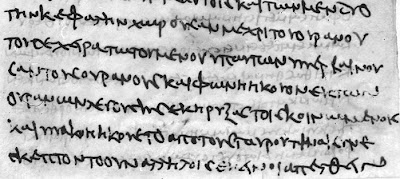
Gospel of Peter  (Click to Enlarge)
Enoch (Click to Enlarge)
 P. Cair. 10759 also spans several books and hands, but the Enoch pages have the closest similarity to Codex W.   Of particular interest is one feature, namely the variation in line thickness based on the angle of the 'nib' or quill used to write the letters.   This itself seems to suggest a much later date for this section of 10759, than may have been at first assigned to it.   The other pages (e.g. Peter) show instead the typical 'painted on' look of a brush-like implement or soft quill.   Indeed, Enoch resembles more the typical hand of the late 3rd or 4th century scriptorium than the early papyri.

We have already referred to Schmid's excellent and thorough article in  The Freer Biblical Manuscripts (2006), Ed. Larry W. Hurtado, and we will quote his passage of Sanders here:
"Hand 'c' [of Enoch] bears a much closer resemblance to the hands of W...The ease, grace, and slope of the hand remind one strongly of the first hand of W, but the shapes of many of the letters, notably  γ ε κ μ σ ω  are far closer to [the 1st quire of John in W]. I see no reason for not considering the two hands of the Enoch fragment contemporary.  It [Enoch] has been dated to the 6th century, but though both hands are somewhat more developed types than the hands of W, I should not place the date later than the end of the 5th [century]." (Sanders, 137-8, in Schmid, p. 239)
Here Sanders is already jockeying to secure an earlier date for his Codex W, but the problem of the anachronism of P. Cair. 10759 is quite glaring!  -  It has already been dated to the 6th century A.D., and yet it is probably the closest thing to Quire 1 of John in Codex W we are ever going to find.  In other words, despite Sanders' cleverness, this is really evidence for dating W to the 6th century palaeographically, not the 5th century.

And if so, trying to make Codex W the archetype of other 5th/6th century witnesses is a naive and flimsy proposal.   But why does it matter?   Because Codex W is now no longer an early "4th or 5th century" witness to other palaeographic features, such as outdented and enlarged letters, slanted varying-width styles, etc.  - But rather, a very late witness.

mr.scrivener

Monday, March 14, 2011

Redating Codex W based on the Obvious...

Click to Enlarge: Use Backbutton to return
Consider if you will, Codex W.  This is a surprisingly handsome and refreshing codex, with its own distinct style of "slanted Uncial" script.  Although not unique, it certainly stands out in a crowd of 4th to 6th century manuscripts, for this striking feature alone.   As well, one must consider the great shape the codex is in, something not so obvious from the poor quality photos of the past.  But, apart from the appearance of heavily burnt edges on every page, the bulk of both the parchment and the text itself is quite excellent, almost 'new' looking by comparison with many a fade page of other manuscripts, including the likes of Sinaiticus and Vaticanus (4th century).   Recently, the better quality photos available at CNTSM etc. have allowed a much kinder view of the manuscript.
Like Codex Sinaiticus, the seeming 'newness' of the MS raises an eyebrow next to others of supposed similar date.
Even the burnt edges look suspiciously like either (relatively recent?) fire-damage, or else the kind of oxidation expected in a harsh but dry climate, but where the book remained closed and unused for centuries, protecting its contents.   Of course, dating any manuscript palaeographically is difficult, and one can only hope for a 50 to 150 year range of plausible dates for its making.  As well, even the so-called "best" manuscripts have murky and suspicious origins, and show a complex history of use, travel, correction and even abuse and neglect by various unknowable hands.


Comparative Palaeography:

One of the best checks and balances available for palaeographical dating estimates is a comparison to other existing documents of better known date and origin.   That is why the little-known last few pages of another manuscript become important...

Turn to Codex Nitriensis now for a moment.  This is a 6th century Greek parchment, scraped off and re-used to copy a Syriac commentary.   It sits in the British Museum.    Most of its text is from Luke, and this part of the manuscript has been dated to the 6th century with strong certainty.

 Sometime between the late 8th and early 9th century AD, Simeon, a monk at the convent of Mar Simeon of Kartamin, copied a Syriac text for Daniel, episcopal visitor (periodeutes) of the district of Amid in Mesopotamia (see notes in Add. MS 17211, ff. 53r and 49r). We owe to this event the partial survival of several older copies of Greek works, since Simeon reused parchment sheets from which Greek text had been scraped or washed off to copy the treatise against Joannes Grammaticus of Caesarea by the author Severus of Antioch. Today, Simeon's Syriac copy survives in two manuscripts at the British Library. The Syriac text has been rebound to reconstruct the sequence of the underlying (scriptio inferior), barely visible Greek texts of a 5th century copy of Homer's Iliad (Add. MS 17210) and a 7th century copy of the Gospel of Luke (Add. MS 17211, ff.1-48) as well as a 7th or 8th century copy of Euclid's Elements (Add. MS 17211, ff.49-53).

Add. MS 17211 is, of course, better known as 'Codex Nitriensis', betraying the fact that Simeon's manuscript once belonged to the convent library of St Mary Deipara in the Nitrian Desert of Egypt. Its text, containing parts the Gospel of Luke, is also known in New Testament scholarly circles under its Gregory-Aland 'number' R or 027.

Many ancient texts survive as palimpsests, the faint remains of texts on reused parchment that sometimes reappear over time or are recovered with the help of modern technology.
 The British Museum gives the following information:
6th century, 'Codex Nitriensis', a palimpsest, 9th century, containing Severus, Patriarch of Antioch, Treatise against John Grammatikos, chapters I-VIII, XX-XXI (Syriac) written over parts of the Gospel of Luke (Greek) (Gregory-Aland R = Gregory-Aland 027)

The style of the writing and caligraphy closely resembles Codex Alexandrinus and portions of Codex Sinaiticus.  Here is a sample:

Codex Nitriensis - Luke: Click to Enlarge


What is rarely noted however, is that the last few pages of this palimpsest have another work hidden under the Syriac, in another script:   Its a fragment of the Elements of Euclid, and it also has been firmly dated, to the 7th or 8th century:

The British Museum describes this portion as follows:
Euclid, Elementa (TLG 1799.001) , books X and XIII (7th century or 8th century)

Click to Enlarge
Click to Enlarge

How was this date arrived at?   By a knowledge of the scriptorium/monastery where it came from, and most importantly, by the palaeography of its writing!
And that's the point:  This style of writing has been positively identified as 8th century, and it is the very same style of writing as found in Codex W.

Textual critics had originally wanted to date Codex W as much earlier, i.e. 5th century, because of course it was an interesting copy of the Gospels with unusual readings. (It was classed as a "Caesarean" text-type by Streeter etc.).

But palaeographically, this date appears pretty unrealistic, given that the unusual style of writing has been pegged at the 7th or 8th century, at the very location where in the 4th and 5th centuries the style of Alexandrinus was produced instead.

mr.scrivener