Showing posts with label MS production. Show all posts

Monday, May 2, 2011

Uncial Talk (4) - MS Illumination, C. Nordenfalk

Croatian Initials
Again we continue the series with a short quotation from another great book on the history of manuscripts, Book Illumination, Early Middle Ages, by Carl Nordenfalk, Curator, Nat. Mus. Sweden (1957, 1988, 1995). 
"...But though the art of the illuminated MS was typically medieval, it was not, like the stained-glass window for example, invented in the Middl Ages.  Long before this, in ancient Egypt, the papyrus rolls...were supplied with colored illustrations.  And though the Greeks of the Hellenistic Age did not give illumination a leading place... there can be no doubt that illustrations often figured in their books.  ...as guide-marks..these were all the more useful since in early MSS columns were not numbered [or indexed].
During the 2nd - 4th centuries A.D. the papyrus scroll was gradually supplanted by the vellum codex, which furnished new support for illustrations...for portraits of authors, ...inserted in the columns of text, usually without frames or backgrounds. 
The oldest extant miniatures in painted frames date without exception to the 4th century A.D. ...when classical culture was beginning to decline.  the 'illusionist' technique of antique painting...perpetuating the art of previous centuries...was particularly striking during the Carolingian renaissance.   The Roman Calendar for 354 A.D. is a case in point; nothing of it survives, but we have 16th-17th cent. Carolingian copies...reproduced so faithfully that one is hardly conscious of the intervention of the Carolingian copyist. 
We learn from Egyptian papyrus that in book rolls of the Hellenistic epoch it was already customary to frame tabular texts with ornamental colonnettes. 
A richly decorated Bible was used as a model by painters at Tours in the 9th century.  Four large-size pictures, to fo rthe Old and two for the New Testament, sponsor an interpretation of the doctrine of Redemption, intended to counterblast the Manichean heresy, possibly a 'proclamation' of Pope Leo the Great (440-461 A.D.).   Classical details such as heads and gestures, ...perspective, link up with earlier MSS.  ...however, ...the tendency to bring figures forward, and diversity is replaced by smaller selection of types...the beginnings of a new pictorial language that, after gaining ground in the late 5th century, attained its culmination in the reign of Justinian.  
...
During the 6th century book production passed more and more into the hands of the Church and the copyists were chiefly employed on making Gospel Books.  But the time was not yet ripe for a final break with the art tradition of antiquity.  Judging by surviving works, the only decorative elements of the Gospel Books in 4 / 5 cases were limited to simple linear ornaments around the colophons.  only the Canon Tables or "concordances", invented by Eusebius of Caesarea (d. 340 A.D.) formed a real exception, having decorative arches.  This type of decoration soon became standardized, and Jerome employed them in the West for his new Latin Vulgate.
That no examples earlier than the 6th century are extant can be explained by the pillaging of Italian churches in the intervening period.  ...
During the period before political upheavals and pariticularly the Arab invasions of the 7th century had almost extinguished the art of the illustrated book in the Latin countries around the Mediteranean basin, an important atelier somewhere in southwest Europe produced a MS whose full-page pictures excel those in all others of this period, the so-called Ashburnham Pentateuch. " (selections abbrev., p. 1-24)


mr.scrivener

Wednesday, April 20, 2011

Identifying the Animal in a Parchment or Vellum

The following information cna be useful in identifying what animal was used to make a parchment or vellum folio:

"Goatskin
Goatskin leather has a characteristic follicle pattern consisting of rows of hair pores, sometimes predominantly parallel and lying in the grooves of the grain. The grain exhibits numerous variations. Terms best avoided: Turkish leather, morocco, shagreen, and saffian.

Sheepskin
As a rule sheepskin leather - notably that of wool sheep, rather than hair sheep - has a smoother surface and a less pronounced grain than goatskin; the hair pores are arranged in groups rather than rows. Sheepskin makes an inferior covering material: the removal of the high amount of fat (up to 30 %) during manufacture gives it a loose structure. Moreover, the upper layer is weak and easily damaged (chafed). Sheepskin is often impressed with an artificial grain (especially in the nineteenth century after being finished with water- and solvent-based finishes - editorial note) in imitation of better/more expensive kinds of leather.
Alum-tawed, red-dyed sheepskin is often used for binding purposes. Basan is a vegetable-tanned, natural sheepskin (its beige colour comes from the tanning).

Calfskin
Calfskin has a smooth surface and a very dense and random follicle pattern. Alt-hough usually vegetable-tanned it is occasionally alum-tawed. It is often dyed, sprinkled and so forth. Cowhide is too thick to be used for covering material, but has been used for straps and (usually alum-tawed) for bands.

Russia leather
The leather of young cattle, tanned with willow bark and impregnated with birch tar oil is called Russia leather. In most cases it is finished with an artificially applied check pattern.

Pigskin
Pigskin has a characteristic follicle pattern made up of groups of three and visible to the naked eye, and a not particularly pronounced grain. It is usually alum-tawed (and has often turned sallow and stiff).

Sealskin
Sealskin comes in fine and coarse grain variants. The follicle pattern is irregular and independent of the grain (hence it is found on the rises as well as in the hollows). There is some resemblance to goatskin and it has an oily feel."

Methods of preparing parchment also can give clues as to animal and the date it was made:

"
Parchment was used chiefly for writing, first on a scroll - as is still the case in Israel - and from the second century BC onwards in book form. To make a book, the rectangular cut sheets might be folded one or more times. The skins of sheep and goats from the areas round the Mediterranean were rarely more than 50 cm long by 40 cm wide. In northern regions we find larger skins and also calfskins being used to make books.
The term pergamena is first used in the Edict of Diocletian (301 AD); until that time the term membrana had been used. It is generally accepted that the use of a new term indicates a new or modified product, but so little is known about the parchment of those days that it is impossible to say with any certainty whether this was the case here.
One of our few informants about pre-Christian times is the (unreliable) Roman historian Pliny. He writes that the king of Pergamon (in present-day Turkey), Eumenes II (197-159 BC), was forced to look for alternative writing materials when the import of papyrus from Egypt was suspended. This is supposed to have led to the invention of parchment. Although parchment had been known at least eight hundred years before this date, Pergamon did have a reputation for good quality parchment in classical antiquity. The great change occurred around the 4th century AD, when people started manufacturing parchment using lime water. Until the fourth century skins were mostly treated with salt, flour and other vegetable products that were used to remove the hairs and to prepare the skin. The lime water method may have been introduced by Jews and Arabs to Spain in the early Middle Ages, after which it spread throughout the rest of Europe. Jewish parchment was lightly tanned on the surface with vegetable tannins. Another technique, the splitting of skins, was also known to the Jews and Arabs, even before the Middle Ages. In the West the traditional procedure to obtain the required thickness was to shave the full skin.
Formulas and depictions of parchment manufacturing have come down to us, especially from the late Middle Ages. There is considerable correspondence between these mediaeval formulas and those used by modern parchment makers, and even the processing and tools have not changed fundamentally. For the most part, parchment manufacture is still a matter of handwork.

Manufacture

The definition of parchment used in this publication and taken from Kneep en Binding, states that it is a skin treated with lime water and dried while stretched. This implies that all parchment-like skins that are treated with other substances, such as alum and enzymes, or have been given a surface tanning, or been dried unstretched, cannot properly be called parchment. However, these variants are seldom encountered in bookbinding conservation.
One of the oldest and most detailed descriptions of this lime water method is found in an early 12th-century formula. (Theophilus Presbyter, Schedula diversarium artium. British Museum MS. Harley 3915, fol. 128r.) More modern formulas (i.e. up to the end of last century), indicate how parchment is made 'nowadays'. If we compare the different formulas we find that the oldest does not explain the process whereas modern formula preparations often give very elaborate explanations.
Modern formulas, like those of the twelfth century, begin by soaking the skins in water so as to restore the moisture lost between fleecing and preservation. Soaking swells the skin, thus allowing the lime to penetrate more deeply, and rinses away the salt used as preservative.
In the twelfth century the skins were then put into a lime-water bath that had usually already been used for unhairing. The skins remained in this bath for about eight days (but twice as long in winter). In modern formulas the rinsed skins are not put into a lime-water bath, but placed over a wooden beam and trimmed on the flesh side with a blunt knife. This stretches them a little and removes dirt and remnants of flesh. It seems reasonable to assume that this was also done in the Middle Ages.
In the Middle Ages unhairing was done on the wooden beam straight after the lime-water bath. Modern formulas sometimes refer to a 'lime dressing' applied to the grain side of the skins, after which unhairing takes place. However, lime water was also used.
In the course of the nineteenth century, sodium sulphide was added to the lime water to speed up the unhairing process. During unhairing - with a curved or straight knife - the hair roots and the content of the sebaceous and sweat glands were also removed as much as possible. The skins were then put into a fresh lime-water bath (about eight days in the Middle Ages, one to three weeks in around 1900, depending on the size of the skins). This opens the skins up for the new, fresh lime and care must be taken not to 'burn' the skins with an excessively strong lime solution. After removal from the lime water the skins are returned to the wooden beam to be scraped clean once again on the flesh side.
Threads attached to tapered wooden pegs are then fastened to the edge of the wet skin. The pegs in turn are inserted in holes around the edge of a square, round or rectangular stretching frame. By turning the pegs the skin can be stretched into a smooth, creaseless surface. Stretch drying is essential for making parchment for it causes the fibres to lie in a flat plane parallel to the surface. Stretching also makes the parchment opaque. Rewetting manufactured parchment allows the stretched fibres to relax with the result that when the material dries again it becomes rough and horn-like.  Consequently, parchment should only be dampened if it is allowed to dry in a stretched condition.
In the medieval formula stretched skins are scraped on the flesh side with a sharp, semicircular knife (drawing 7), and left to dry in the shade for two days. After drying they are dampened again and the flesh side scraped with powde-red pumice.
In modern formula preparations the skin is also scraped smooth on the flesh side with a similar semicircular knife. Scraping is accompanied by the continuous addition of lime water. For this operation slaked lime is used, prepared by temporary exposure to air in order to diminish the etching effect. During this treatment the stretcher is in a horizontal position, with the flesh side up. The grain side is treated only with powdered chalk, which has a polishing effect. This is followed by further polishing with pumice or powdered pumice. Split skins are treated in the same way on both sides. Scraping and polishing is done several times until all loose fragments of skin on the flesh side and the papillary layer of the grain side have been removed. Removing the papillary layer is important because it also removes the pigmentation from the skin (black-patched calves!).
After scraping and polishing the parchment is dried in the shade for some days. When it is thoroughly dry, it is taken from the stretcher and, if necessary, cut to measure.
The old and the later formula preparations use much the same method of treatment. Similarly, tools and equipment, such as stretchers and knives, are virtually the same. In eight hundred years little has changed in the manufacturing of parchment; the main difference between then and now is in the use of chemicals. Modern machines make it possible to split the skins to the required thickness before they are turned into parchment. This produces a flesh split and a grain split. In antiquity sheepskins were also split into two layers, without the help of machines. This was possible because sheepskins consist naturally of two clear layers separated by a loose, fatty layer. The practice of splitting skins ended after the 3rd century, however. In order to give both sides of the skin the same surface, the grain was scraped off with a razor-sharp, semicircular or round knife. A knife-sharpener was used to make a burr on the edge of the blade, thus turning it into a kind of scraper. With the grain removed, the surface became velvety to the touch. This parchment was particularly suitable for books, because there was little difference between the verso and recto sides of the pages.
Nowadays, too, the grain is often scraped (using machines and sandpaper) instead of being split. Where the whole skin (grain and fibre network layer) is left unscraped, as for instance for bookbinding parchment, pigmentation is removed with alum, enzymes or a bleaching agent (hydrogen peroxide).

Parchment terminology

Like leather, parchment is also given various trivial names. Many of the terms we use hail from abroad, and this may cause confusion. It all started in France, where the term velin was used alongside parchemin. This gave rise to vellum which is used especially in Great Britain and, sometimes incorrectly, in the Netherlands. The British parchment manufacturer makes a distinction between parchment and vellum. Parchment is traditionally used for the split skin, vellum for the complete skin. In British technical jargon the terms sheepskin vellum and sheepskin parchment are used, although not always consistently. Dutch terms such as francijn and forril give no indication as to either the original animal or the method of manufacture.
It is important, especially for documentation relating to parchment conservation, that the terminology used be as unambiguous as possible. For parchment, as for leather, this publication has adopted the terminology as used in Kneep en Binding where parchment is defined as an 'animal skin, preserved by treatment with lime, stripped of hair and remnants of flesh, and dried while stretched, which causes the arrange-ment of the skin fibres to change, and its characteristic qualities to appear (slight thickness, a certain transparency and a light colour). It is sometimes possible to distinguish between the hair side (traces of hair pores; often smoother) and the flesh side (rougher structure); but some forms of treatment make it almost impossible to make this distinction.
Most parchment is made from sheep, goat or calves: sheep, goat or calf parchment; these are distinguished mainly by the hair patterns.'

mr.scrivener

Tuesday, April 19, 2011

Sad Truth: The Missing MSS of the 4th - 14th centuries


In the following concise account, we can simultaneously learn about the switch from papyrus, the preference for parchment, and the destruction of the bulk of ancient gospels all in one pass.  Here we can read another large piece of the heartbreaking puzzle of what happened to the thousands of Gospel manuscripts made between the 4th and 10th centuries:

“Paper came before its time and had to wait for recognition. It was sorely needed. The Egyptian manufacture of papyrus, which was in a state of decay in the 7th century, ceased entirely in the 9th or 10th. Not many books were written during this period, but there was then, and for at least three centuries afterwards, an unsatisfied demand for something to write upon. Parchment was so scarce that reckless copyists frequently resorted to the desperate expedient of effacing the writing on old and lightly esteemed manuscripts. It was not a difficult task. The writing ink then used was usually made of lamp-black, gum and vinegar; it it had but a feeble encaustic property, and it did not bite in or penetrate the parchment. The work of effacing this ink was accomplished by moistening the parchment with a weak alkaline solution and by rubbing it with pumice stone. This treatment did not entirely obliterate the writing, but made it so indistinct that the parchment could be written over the second time. Manuscripts so treated are now known as palimpsests. All the large European public libraries have copies of palimpsests, which are melancholy illustrations of the literary tastes of many writers or bookmakers during the Middle Ages. More convincingly than by argument they show the utility of paper. Manuscripts of the Gospels, of the Iliad, and of works of the highest merit, often of great beauty and accuracy, are dimly seen underneath stupid sermons, and theological writings of a nature so paltry that no man living cares to read them. In Some instances the first writing has been so thoroughly scrubbed out that its meaning is irretrievably lost.
“Much as paper was needed, it was not at all popular with copyists; their prejudice was not altogether unreasonable, for it was thick, coarse, knotty, and in every way unfitted for the display or ornamental penmanship or illumination. The cheaper quality, then known as cotton paper, was especially objectionable.  It seems to have been so badly made as to need governmental interference. Frederick II, of Germany, in the year 1221, foreseeing evils that might arise from bad paper, made a decree by which he made invalid all public documents that should be put on cotton paper, and ordered them within two years to be transcribed upon parchment.  Peter II, of Spain, in the year 1338, publicly commanded the paper-makers of Valencia and Xativa to make their paper of a better quality and equal to that of an earlier period.
“The better quality of paper, now known as linen paper, had the merits of strength, flexibility, and durability in a high degree, but it was set aside by the copyists because the fabric was too thick and the surface was too rough. The art of calendering or polishing papers until they were of a smooth, glossy surface, which was then practised by the Persians, was unknown to, or at least unpractised by, the early European makers   ...
“There is a popular notion that the so-called inventions of paper and xylographic printing were gladly welcomed by men of letters, and that the new fabric and the new art were immediately pressed into service. The facts about to be presented in succeeding chapters will lead to a different conclusion. We shall see that the makers of playing cards and of image prints were the men who first made extended use of printing, and that self-taught and unprofessional copyists were the men who gave encouragement to the manufacture of paper. The more liberal use of paper at the beginning of the 15th century by this newly-created class of readers and book-buyers marks the period of transition and of mental and mechanical development for which the crude arts of paper-making and of black printing had been waiting for centuries. We shall also see that if paper had been ever so cheap and common during the Middle Ages, it would have worked no changes in education or literature; it could not have been used by the people, for they were too illiterate; it would not have been used by the professional copyists, for they preferred vellum and despised the substitute.
“The scarcity of vellum in one century, and its abundance in another, are indicated by the size of written papers during the same periods. Before the sixth century, legal documents were generally written upon one side only; in the tenth century the practice of writing upon both sides of the vellum became common. During the thirteenth century valuable documents were often written upon strips two inches wide and but three and a half inches long. At the end of the fourteenth century these strips went out of fashion. The more general use of paper had diminished the demand for vellum and increased the supply. In the fifteenth century, legal documents on rolls of sewed vellum twenty feet in length were not uncommon. All the valuable books of the fourteenth century were written on vellum. In the library of the Louvre the manuscripts on paper, compared to those on vellum, were as one to twenty-eight; in the library of the Dukes of Burgundy, one-fifth of the books were of paper.  The increase in the proportion of paper books is a fair indication of the increasing popularity of paper; but it is obvious that vellum was even then considered as the more suitable substance for a book of value.”  (- De Vinn, quoted for review from "Medieval Ink")
 mr.scrivener

Sunday, April 17, 2011

Dating MSS by Vellum Color

Some brief notes are recorded here for the assistance of palaeographers:

From:  THE OTTO F. EGE PALEOGRAPHY PORTFOLIO page

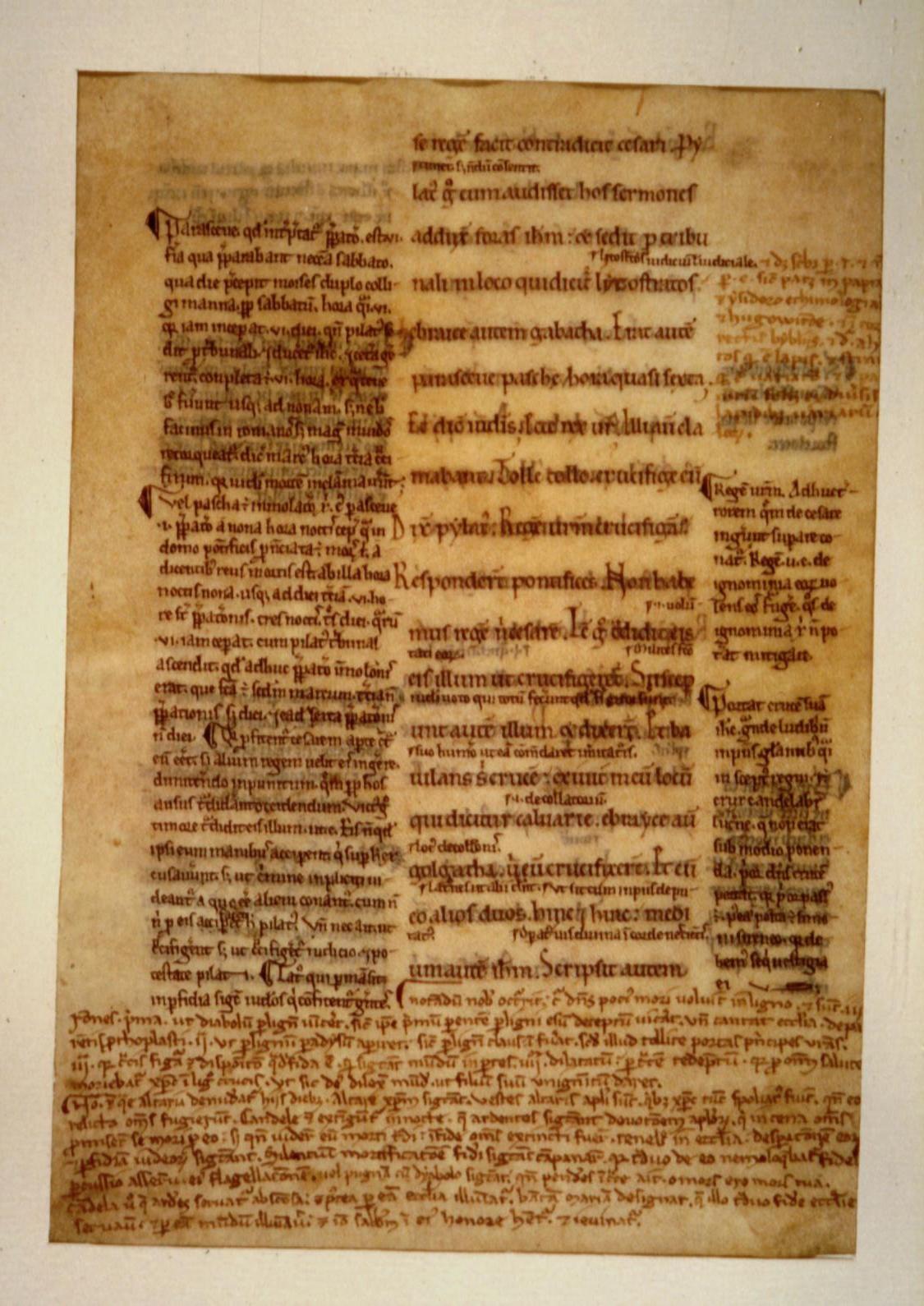
1. Switzerland: New Testament ( Testamentum Novum, cum Glossis Bedae, Hieronymi, et Gregorii).
Early XIIth Century. Latin Text; Revised Carolingian Script.
John 19.7-12, recto; John 19:12-19, verso.
... interlinear glosses and commentaries from the writings of Bede, Jerome, Gregory and other Church Fathers. These were inserted at various times during the following century around a central panel of the original text. All hands based on revival of early Carolingian minuscule. the beginning of the trend to compactness and angularity is seen in many of these later additions. 

'The colour and texture of the vellum is frequently an aid in allocating a manuscript to a certain district and time. The XIIIth century skins are often yellower than those of later dates as the result of the fact that a weaker lime-water solution was used in the bleaching process.'


3. Italy: Lectionary (Lectionarium; Secundam Lucam)
Middle XIIth Century, Latin Text; Revised Carolingian Script

 
A Lectionary contains selected readings from the Epistles and Gospels as well as the Acts of the Saint and the Lives of the Martyrs. These were read by the sub-deacon from a side pulpit. This practice necessitated that they be written in a separate volume, apart from the complete Missal. This fine large bookhand shown here, suited to easier reading in a dark cathedral, is a revival of the script developed nearly four centuries earlier in scriptoria founded by Charlemagne. Maunde Thomson calls this Lombardic revival the finest of all European bookhands. Even the XVth century humanistic scribes could not surpass it for beauty and eligibility.
 
The tone or hue of ink frequently helps allocate a manuscript to a particular district or century. Ink of brown tone is generally found in early manuscripts, less frequently after 1200 A.D.
 

"The quills used in writing were obtained from the wings of crows, wild geese, and eagles. To keep them sharp and their strokes of uniform width required skill and great sensitivity in hand pressure. It would be difficult to imitate or approximate the fine details even with the special steel lettering pens of today."

mr.scrivener

Monday, April 11, 2011

Vellum Bindings: 1750s - a quick peek

Recently we began to investigate the production of vellum, particularly that taken from unborn or recently born animals (and briefly the practice of book-bindings from human skin also came forward).   As vellum production appears largely to have become a lost art, it was interesting to note that a 'fine vellum' book cover was found on a recent antique book for sale on Ebay, namely a printing of a Greek strategy book.   Here are a few shots of this cover, and the vellum is certainly striking for its 'milky-white' look, while still maintaining a translucent edge according to the photos:


mr.scrivener

Monday, April 4, 2011

The Alum Scrolls of Eastern Turkey

Many materials have been used in the production of scrolls and books, and perhaps none has been rarer, or misunderstood as much as the use of aluminium as a writing-material.
Aluminium scroll-making was first introduced in Iraq and Eastern Turkey, and began soon after the smelting of Mongolian bauxite had achieved the subtlety to make it viable for weapons, ornamental decorations for Icons, and of course the thin sheets used for scrolls, made by laboriously hand-rolling using carefully honed and precise steel rollers mounted on hardwood frames.

Many objects, as this Imperial wall decoration for the Khan's royal bedroom, were only recently found to be tooled aluminium, painted using special veneers.

Aluminium Floral Decoration in Relief

Other uses included box and book covers, where the heavier Aluminium sheets of the early times were better suited and more durable, than woods and leathers.

Early Aluminium Box Cover

Special tools were need to work the stiffer, more brittle aluminium sheets, as opposed to softer and more pliable metals such as copper and gold.

Aluminium Scroll-making tools


Military use of Aluminium sheet, made into continous rolls from early wooden outdoor smelters, began with the making of the vast lists of personnel and supplies needed for the early Mongol campaigns.   The invention of 'tin-snips' of various sizes to accommodate the new medium was developed out of the popular sheep-shears originally used to remove wool.


The Legendary Aluminium Army Rosters,
Kublah Kahn, Copenhagen Museum
Early attempts to make Aluminium sheets involved the careful shaving of solid Aluminium bars, specially cast for the purpose.  A dedicated lathe was used equipped with a hardened steel blade, to shave the aluminium into thin continuous strips.   Below are pictured cast aluminium bars stored for use by the Mongol army accountants:

Aluminium Bars prepared for 'turning'.

In order to save costs and materials, aluminium was often made as thin as possible, and backed by heavy felt to give it durability and a solid feel.  But scribes were prone to poking holes in the thin surface, and so the practice was discontinued.
Mixed media Aluminium/felt scrolls
The Mongol artisans became very good at surfacing and patterning aluminium for decorative use in book manufacture.  Featured below are various Islamic patterns from the later Aluminium Age of the Levant.

Semi-automated pattern stamping from Turkey

Techniques of dieing and fixing color to aluminium, now known chemically as anodization, was practiced from ancient times, but improved as religious centers like Venice took up the expanding trade and manufacture of aluminium codices.


Aluminium scroll colors available c. 640 A.D.

Of course the new materials were applied in all spheres of life in this central area of Asia Minor.   Here below are displayed common cooking implements made from aluminium and more rarely, pewter.


Turkish Pottery from the Aluminium Era


mr.scrivener

Saturday, April 2, 2011

The Cost of Imported Papyrus

 The Basic Method of Manufacture of Papyrus

Papyrus manufacturing process has not changed in thousands of years :
1.  The papyrus plant grows in the Nile’s fresh water.It has long roots and stems and the ancient Egyptians used it in building ships and making Papyrus paper.
2.  The outer bark of the papyrus plant is removed and the inner pith sliced into thin strips which are subsequently hammered to break the fibers and drain the water.They are then reimmersed into ordinary water for three days until the fibers become flexible and transparent.
3.  The papyrus strips are then cut to the required length and placed on a piece of cotton each at a slight overlap making two layers one horizontal and the other vertical.
4.  The papyrus sheets are put between (used to be big stones) two pieces of cardboard and placed under a hand press until dry.The cardboard is changed every eight hours and the drying process takes about three days.
5.  Finally,the papyrus sheets are ready for painting and are given to artists.


The following is taken from the Marxist site, and is apparently under "copyleft" (i.e., open copyright):

The Annales School 1929

The Price of Papyrus in Greek Antiquity

by Gustave Glotz


Source: Annales d’histore économique et sociale. 1929, Vol 1, no. 1;
Translated: for marxists.org by Mitchell Abidor;
CopyLeft: Creative Commons (Attribute & ShareAlike) marxists.org 2009.

Scholars have often asked what the price of paper of papyrus fiber was in the countries of ancient Greece. The question is not only of great interest for the history of civilization. Since it is a matter of a product and commerce exclusively Egyptian, it also has its importance in economic history and, as we shall see, in the history of international relations.
Until 1912 we only found three indications on the question in our literary and epigraphic documents, which were in any case contradictory. While lamenting the rarity of information, most authors maintained that papyrus had always been dear. Only Gardthausen was of the opinion that it was dear before and after the Hellenistic period, but for four centuries the low cost of primary materials and labor, as well was the facilities for fabrication, allowed Ptolemaic Egypt to furnish an inexpensive product to the Mediterranean world. When in 1912 Durrbach published the accounts of the Delian hieropes of the period 314-250 [BCE] I observed in an article “On the Price of Goods in Delos” that these accounts provided a fair number of new indications concerning the price of papyrus and refuted those authors who had treated the question. But I must note that this article remained in those shadows into which writings published in scientific reviews are plunged: Schubart, in his excellent Einfürung in die Papyruskunde, which appeared in 1918, says (p. 39): “Ueber die Preise des papyrus wissen wir trotz verienzelten Angaben ungefähr nichts. Billig was er nicht;” and he gives the reasons for its dearness which he admits for all of antiquity, without distinction as to period. Now that Durrbach has published a second series of Delian inscriptions (1926) and is going to publish a third whose proofs I have read, and as a result of which I have dispose of new data for the years 231-179 BCE, I would like to return to the overall question. It is worth the trouble, since to three indications from the past, which apply to the years 407, 333, and 322, are added – independently of those provided by papyrology – 18 others which are spread out over thirteen years between 296 and 179.
We know that Egyptian papyrus had been imported to Greece since the Sixth Century, but it was rare because of its price. It is for this reason, Herodotus tells us, that the Ionians long employed, in order to write, the skins of sheep and goats which, he adds, the barbarians still do, obviously those of Asia. At the end of the Fifth Century the precious sheets were much more widespread in Greece, but remained dear. In 407 the epistates[1] charged with the labors at Erechteion [2] bought two of them in order to transcribe the copies of their accounts that they were obliged to deposit in the archives. They paid 1 drachma, 2 obols per sheet. This was a high price at a time when a day’s work was worth 1 drachma, even for an architect.
It is true that they oppose to this price, found in an official act, one they think they can deduce from a literary text. Plato has Socrates say that on the square of the agora we can find Anaxagoras’ “Treatise on Nature” for no more than a drachma. Dziatzko maintained that if the manuscript was worth a drachma, the paper certainly wasn’t worth more than a third and that, the volume being composed of several pages, the sheet couldn’t have cost more than one obol. But the copies which Socrates speaks of with a smile are low quality copies. The booksellers of the market had not the least pretention of producing out of date items for the price of new paper or, and with even more reason, the price of paper increased by the salary formerly paid in the past to the scribe, a salary which, on its own, represented more than one day of work. Plato thus gives us precious information concerning the sale of used books, but he gives us no information on the value of papyrus in the Greece of his times.
The market price of the year 407 held steady for three quarters of a century. In fact, in Epidaure, according to Thymele’s accounts, they pay 4½ Aeginetic [3] obols, that is, one Attic drachma and ½ obol, for a sheet on which is to be written an expenditure record. We would like to have a certain date for this. Unfortunately, all that we believe is that the purchase in question was made in at least the sixteenth, and perhaps in the twenty-seventh year after the beginning of the works in progress, and that these works began around 360, thus around 344-334 BCE. All of this is quite vague. Nevertheless, I think we can be more precise. Four years before this papyrus purchase the accounts mention a purchase of lead at twice the normal price. Such an increase can only be explained by a cause similar to the one that produced the same effect in the final years of the Fifth Century, i.e., by a total cessation in mining exploitation in the Laurion basin. One of these crises was determined by the presence of Spartans in Decelie and the desertion of slaves; the other one could only have been by the arrival of the Macedonian army on the Attic border, after the battle of Cheronee. It is thus four years after 438/7, in 434/3 that the sheet of paper in Epidaure was worth more than one Attic drachma. Thus, for three-quarters of a century the price hardly varied, at least in normal times.
But suddenly, ten years later, in 322, the plea “Against Dionysodoros” teaches us that the great merchants of Athens write their most important contracts on tablets worth two chalkoi [4] and on pieces of paper every bit as inexpensive. Is this one of those exaggerations so customary among lawyers? In truth, it is quite possible that the Pseudo-Demosthenes gives a real price for the tablet and an approximate price for the papyrus. But he wouldn’t have dared to speak as he did if papyrus still cost 32 times more, as in 407, or 26 times as in 333. Nevertheless, we could continue to quibble about this if we didn’t have any other, similar indications.
The great, the inestimable advantage that the Delos inscriptions present in the economic history of antiquity is that they give a series of prices that spread out across a century and a half. The differences are characteristic, and the highs and lows always have a meaning that one must sort out. A few years ago I was able to demonstrate by a typical example, that of a product as small as the pea, how the Delian market price reflects Greek history over a century. We will see that the variations in pricing of papyrus are not without their importance.
The first indications the hieropes [5] of Delos provide us concerning the price of paper date from 296. They number two for that year, both of them in conformity with that given by the orator of 322. 1 - A sheet (harthς) is paid for at a price that mutilation by a stone renders uncertain, but is perhaps one obol and in any event remains below one drachma. 2- For one drachma one can have several scrolls (bidlia), i.e., at least two scrolls of at least two sheets and probably of more than two sheets. The sheet is thus worth 1 ½ obols at the very most, but it is much more likely worth much less and could even have been, as in 322, a single tetartemorion.
We thus have a period of at least 26 years (322-296) for which a base price is certified.
But this period is exceptional. From the year 279 until 179 the Delos accounts give us 16 prices for 12 years. All these pries are higher, not only and by a large amount to those of the preceding period, but even to those of 407 and 333.
Twice (267,231) the sheet cost....1 dr. 3 ob.
Five times (274, 250, 200, 179).... 1 dr. 4 ob.
Once (250)........ 1 dr. 4 ob. 1/4
Once (250).... 1 dr. 5 ob.
Once (218)..... 1 dr. 5 ob. ½
Twice (279, 204).... 2 dr.
Two and probably three times (269, 258, 224-222).... 2 dr. 1 ob.
Once (267).... At least 10 dr.
We thus have a series of prices that includes seven degrees, from 9 to 13 obols, after which, by a great leap, we arrive at the single price of 10 drachmas. We shouldn’t think, though, that over the course of this century the price varied with the times: it is 1 drachma 4 obols in 274 as well as in 179, and in the year of 250 it goes from 1 drachma 4 obols to 1 drachma 4 ¼ obols. Even more, in the year of 267 alone we find both the lowest and highest of all. This latter price should be set aside: 10 drachmas or more could only be asked for papyrus whose age-old renown places it above all others, that which was 11 fingers (0 m .20) long and which was distinguished for its fineness, solidity, whiteness, and shine, that which in Egypt was reserved for sacred books and acts of royal authority, (harthς), (ieratihoς), and (basilihoς). As for other prices, they could be asked for for papyrus of ordinary good quality, with the trademark of “The Amphitheatre,” which was produced near the amphitheater of Alexandria, and which was nine fingers (0 m 17) long.
Consequently, if papyrus was inexpensive in Greece since the final quarter or third of the Fourth Century, it again became dear during the first quarter of the Third, and this time forever. Before asking how we can explain the period of decrease noted during the years 322 and 296, let us clarify the beginning and end dates of this period. We have seen in inscriptions that it can be extended 10 years ab initio and 16 years a fine. But if nothing prevents us from beginning it in 332, it doesn’t seem that it lasted until 279. The Delian accounts of the year 281 could, in this regard, provide us with precious information: they mention a purchase of papyrus, but they are mutilated just after the word harthς at the place of the price. In the case where it would have borne a low price it would have, within two years more or less, dated the event that so strongly modified the price of papyrus. But it is more likely that it already had a high price. In fact we know that a few years previously in Greece paper wasn’t on object in wide use by those without much money. Having no choice, poor people did as in the distant époque of ostracism: they wrote on pieces of broken pots. In 283 and 282, when Cleanthe began to take lessons in the Portico he only had at his disposal to collect the thoughts of his master Zeno shards of vases and shoulder blades of oxen. Forced to work in order to live, papyrus was too expensive for him. This anecdote could very well reduce by three or four years the interval into which we can place the return of high prices.
We must now turn to Egypt in order to understand what happened for the first time in the interval from 333 to 332, and a second time forty or fifty years later. For the production and sale of paper was an industry and commerce strictly Egyptian.
Everything indicates that in Egypt paper could be quite inexpensive. The cultivation of the plant was widespread in the Delta. The work demanded care, but wasn’t complicated. Labor was abundant and barely cost more than the price of maintenance. The cost of production was thus not high. It was this very reason that led Gardthausen to believe that before being exploited by the imperial tax authorities papyrus was moderately priced. But as we have seen, this hypothesis is correct for only a limited time. This is not so either for the period prior to 333-322 or for the years after 296-282. Why?
It is because the monopoly that was to make papyrus so dear under the Roman emperors already existed under the pharaohs and was reconstituted under the Lagides [6] We can now see what it was that happened between 333 -322 and determined an enormous drop in paper. It was simply this: during the winter 332-331 Alexander opened wide the gates of Egypt and poured oriental merchandise onto the Greek markets. In replacing national administrations with Macedonian domination it put an end to the monopolies that from time immemorial had made wealthy the temple treasuries and the royal coffers. There then began a reign of liberty in the production and sale of papyrus that still continued at the beginning of the Third Century. We know, and can see in the accounts of Delos, that Ptolemy, son of Lagos, independent satrap since 311, king since 305, had not yet reorganized the monopolies in 296. Otherwise, in a year when the master of the islands, Demetrius Polioricete, found himself in a state of war with the master of Egypt, papyrus, already more dear in 322, would have been nearly unaffordable.
Everything seems to indicate that Ptolemy Soter didn’t change fiscal policy until his abdication in 285. His successor, on the contrary, returned to pharaonic traditions. We know from the “Revenue laws” that in the 27th year of his reign Ptolemy Philadelphus gave a definitive constitution to certain monopolies. This was a reform, not a creation. The price paid for papyrus in 279 and Cleanthe’s anecdote teach us that the paper monopoly had been re-established during the sixth, and perhaps even the second year of the reign. In any case, a reason of this kind was needed for the price of papyrus to be so high in 279, since in that period the commerce of the islands with Egypt was facilitated by excellent relations, as is proved by the invitation addressed to the Nesiotes and accepted by them to officially participate in the Olympic festival and the foundation of the Ptolemaia in Delos.
We possess sufficient information on the papyrus monopoly in the time of the Lagides so that it is impossible for there to be any doubt. Primary matter was purchased from individuals in accordance with the price fixed by the royal administration. The work was done in public workshops, except for the privilege reserved to priests to meet by their own means the needs of temples. Sale was assured by retailers who stocked themselves from the king’s stores. The sale price was thus fixed less often by the cost than by the profit demanded by the tax authorities.
Thus, inexpensive paper couldn’t be obtained even in Egypt. It has often been observed that without the necessity to economize the subject of the Lagides would not regularly have written on the verso of their pages, or even more had recourse to the pitiful practice of the palimpsest. And they would have even less used ostracons if they had had at their disposal a more convenient and cheaper material. Finally, in a country where the respect for the dead was always scrupulously maintained, embalmers would never have wrapped mummies in old discarded paper if they could have had new ones at a good price.
The indications we have on the price of papyrus in Egypt bear a close relationship to those given in the Delos inscriptions of the same period. Between them we find sometimes the normal difference represented by export rights, shipping costs, and the profit of the intermediary, sometimes a large difference explained by a disturbance in commercial relations caused by political events. In 251-250, while the accounts of the Delian hieropes twice give the price of 1 drachma 4 obols, once that of 1 drachma 4 ½ obols, and once that of 1 drachma 5 obols, the Zeno’s accounts mention the price of 1 drachma 1 obol. The difference is hardly greater in the Second Century: while in Delos they pay 1 drachma 4 obols per sheet, retail price, an Egyptian government office pays 100 drachma for 100 sheets, 1 drachma per sheet, semi-wholesale price. It is true that at certain moments the price decreases to below 1 drachma in the country of production. An account from Fayoum indicates as the price of a sheet of ordinary format (harthς) as 4 obols ¾ or 3/8, and the price of small-format sheets (hartidion) as 1 obol the sheet and 8 drachmas the hand of 48 or perhaps 50 sheets. In this case, lacking the precise date, we can’t make a comparison. But around 259-258 we find an enormous spread. The Delos accounts in 258 bear the high price of 2 drachmas 1 obol, perhaps because Egypt is implicated in the Cyrenaic events and the risk of war hinders Greco-Egyptian commerce. Around the same time, Zeno’s accounts mention a purchase of papyrus that the publisher believes he can evaluate, despite the difficulties in reading that he truthfully mentions, as 40 drachmas for 60 sheets, thus 4 obols the sheet. If the number x=60 should truly be maintained for the quantity, for the price we might replace m by n, which would be more in conformity with the market price of the time. It is nevertheless not impossible that the Third Century before Christ already knew this price of 4 obols, which is certified for the middle of the Second Century after Christ. In any case, since the reign of Ptolemy Philadelphus, the price of papyrus in Egypt – even if from 1 drachma 1 obol at its highest it descends to 4 obols at its lowest – still remained above the price paid in the importing nations like Attica and Delos, and even more so in the producing country before the re-establishment of the monopoly.
It remains to examine a document where Gardthausen believed he had found a confirmation of his theory, but which on the contrary leads us to better understand the monopoly on paper. On a papyrus from Tebtynis a comogramatte mentions, in the year 112, the following expense: hartwn i, an (a) r, A, i.e., hatergon for 10 hartai, at 100 (copper) drachmas each, 1000 drachmas.” For Crönert, who examined this text, harthς doesn’t designate a sheet of papyrus, but a scroll, a hand, a scapus of twenty sheets. A purely arbitrary hypothesis. Yet Gardthausen adopts it and after having correctly translated hatergon by Lohn he continues by reasoning as if it were a question, not of a salary, but of a sale price. And here is his conclusion: 10 hands of papyrus are worth the same as 1000 drachmas of copper. Thus one hand costs 100 drachmas, so one sheet costs five drachmas which means, in an era when copper money lost much value in relation to silver money, a reduction of one pfenning. Let us simply return to our text and translate: “Salary for the production of 10 sheets at 100 drachmas each, 1000 drachmas.” It is a matter of a sum owed by the administrators of the monopoly to a worker or a paper producer later on called hartopoioς. In addition, given that the relation of minted silver to copper was then at 1:475, the worker received 0 fr 20 silver per sheet, and not 0 fr 01, as Crönert and Gardthausen think.
The profit to the royal treasury was thus quite substantial, since the price for the sheet for the Egyptians was at least 0 fr 65 silver (4 obols) and even reached 1 fr 15 ( 1 drachma 1 obol). That of Greek importers and resellers was nothing to sneer at, since the price of the sheet varied in Delos between 1 fr 50 silver ( 1 drachma 3 obols) and 2 fr 15 ( 2 drachmas 1 obol).
One can judge from this detailed study how useful it can be to gather and classify figures, however rebarbative in appearance, that are scattered about our inscriptions and papyri.
It could suffice to recall and confront twenty prices scattered over two centuries to cast a bit of light on the economic history of antiquity which the historians of the time have neglected. It is through a series of analogous studies that we will have some precise notions on retail and wholesale commerce, on the general conditions of international exchange.
I chose as an example a product which, in addition, teaches us about the political history, not to mention the intellectual history of the Hellenic countries. It is not a matter of indifference to note one of the effects suddenly produced on Egypt’s material situation by the Macedonian conquest, one of the profound differences that distinguishes the reign of Ptolemy Soter from that of Ptolemy Philadelphus. And we can reflect on the consequences of a system that had as its primary result that of only turning over to consumption a paper as dear as stamped paper is in contemporary societies. The monopoly had hardly been suppressed by Alexander than the Athenian Lycurgus, who was even so a thrifty administrator, had made and deposed in the archives an official copy of the tragic poets, which was quite a lovely beginning for a National Library. But the monopoly reestablished by Philadelphus transmitted to the book the dearness of paper. Thus is explained the incomparable importance that the library of Alexandria immediately took on and maintained for centuries: the Ptolemies furnished it with papyrus either free or at a low price. At the same time, they were masters of its sale overseas at a rate they alone fixed and even – as Evergete II did – prohibited its export.

1. In Athens the epistates presided in the council and the assembly; in the Hellenistic kingdoms the title was given to an agent of the king within the subject city.
2. The most sacred temple in Athens
3. One of the various weight standards for currency
4. Eight chalkoi = One obol
5. Priest/administrator
6. Dynasty of the Ptolemies.


mr.scrivener

Wednesday, March 23, 2011

The Sudden Conquest of the Minuscule Script c. 780-820 A.D.

Upensky Gospels MS: GA-461 (c. 820) - Sample page


I am borrowing this great excerpt on the Upensky Gospels to open the discussion:
"The earliest surviving dated example of Greek minuscule is the Uspensky Gospels manuscript. The codex was probably written in Constantinople by monk named Nicholas. Later it belonged to the monastery of Great Lavra of St. Sabas, known in Arabic as Mar Saba, a Greek Orthodox monastery overlooking the Kidron Valley in the West Bank, east of Bethlehem in Palestine. In 1844 bishop Porphiryj Uspienski took it along with other manuscripts, including a portion of the Codex Coislinianus, to Russia. The Uspensky Gospels MS is preserved in the National Library of Russia in St Petersburg (Gr. 219. 213. 101)." ( - from Cave Paintings to the Internet)

Further enlightenment on the changeover comes from Reynolds & Wilson:

"As the script of this book (GA 461) is by no means immature or primitive, the adoption of this style should probably be dated at least half a century earlier. The place of its origin is not known for certain, but there are some grounds for thinking that it was popularized by members of the important Stoudios monastery in the capital [Constantinople], which a was a well-known centre of book production at a later date. Gradually the uncial hand was abandoned, and by the end of the 10th century it was no longer used except for a few special liturgical books. The new script facilitated the copying of texts by making more economical use of parchment . . . .

"The transliteration of old uncial books into the new script was energetically undertaken by the scholars of the 9th century. It is largely owing to their activity that Greek literature can still be read, for the text of almost all authors depends ultimately on one or more books written in minuscule script at this date or shortly after, from which all later copies are derived; the quantity of literature that is available to us from the papyri and the uncial manuscripts is only a small proportion of the whole. In the process of transliteration mistakes were sometimes made, especially by misreading letters that were similar in the uncial script and therefore easily confused. 
 
The Changeover Process:
At many points in Greek texts there are errors common to all the extant manuscripts which appear to be derived from the same source, and this source is usually taken to be a ninth-century copy. 
 
A further assumption generally made is that one minuscule copy was made from one uncial copy. The uncial book was then discarded, and the minuscule book became the source of all further copies. The theory has a certain a priori justification on two grounds, since the task of transliteration from a script that was becoming less and less familiar would not be willingly undertaken more often than was absolutely necessary, and there is at least some likelihod that after the destruction of the previous centuries many texts survived in one copy only. But these arguments do not amount to proof, and there are cases which can only be explained by more complicated hypotheses" (Reynolds & Wilson, Scribes and Scholars 3rd ed ([1991] 59-60).


mr.scrivener

Uncial Talk (1) Greek and Latin - M. Drogin

In TC, there is often a lot of vague talk and inaccurate use of various terms regarding scripts and styles.   We seek to expand our knowledge of the background with a series here on the various scripts, starting with Uncials.   Sometimes we see "Uncial" and "majuscule" used interchangeably, but I think we can gain precision by consulting those historical investigators of calligraphy.   For openers, I will quote a nice introduction by Marc Drogin, from his book, Medieval Calligraphy (1980):


 Uncial Script - 3rd to 6th Century


Brief History

"In the 1st and 2nd centuries the scribes of Europe wrote most formally in Roman Square Capital and less formally and more conveniently in Roman Rustic.

ROMAN RUSTIC CAPITALS   ca. 4th century

From the square Roman capitals (preserved on the plinth of Trajan’s Column (114 AD),
developed the freer-form and slightly more condensed Rustic capitals. 


Their subject matter was almost wholly non-Christian.  In Rome, Greek manuscripts predominated, since Latin had yet to become the official Church language.  With the demand for church-related manuscripts, it was probable that the primary source was the intellectual community of North Africa, where Latin was the literary language of the Church and the population knew both Latin and Greek.  The scribes there sought an appropriately dramatic Latin script suitable to the importance of their new religion, but some changes had to be made so such a script could be produced more rapidly to fill the demand for manuscripts.  Since the pen more easily and rapidly produces curves than straight lines and angles, scribes began adopting some of the round strokes which were a hallmark of the formal Greek script since the 3rd century B.C.


This adaptation resulted late in the 2nd or early in the 3rd century in a script as majuscule and important as Roman Rustic, but now with its letters wide and curved, reminiscent of the finest Greek formation.  When the Church in Rome adopted Latin as its official language and sought to represent itself in a script both different from the pagan literature's Roman Rustic but familiar to people accustomed to that script or accustomed to Greek-Uncial, a formal but quick script was the obvious  choice.  By the 4th century it had become an established script for manuscripts of importance, and by the end of the 5th century it had eclipsed the pagan scripts and reigned supreme."  (Drogin, p. 93)

Latin Cod. Bobbiensis (k) (c. 400 A.D.)


Latin Uncial  -  circa 5th century


Click to Enlarge


MS GA-087 - Θc (6th cent) - Click to Enlarge


mr.scrivener

Wednesday, February 9, 2011

MS Making, fact and myth

James Snapp Jr. Has recently posted some useful information on MS making in his review of White's debate with Moorman
...(15) White said that for the first 300 years of the church’s existence,
“You couldn’t go to the rich people to have nice manuscript copies made at that particular point in time. And so they would use these abbreviations for, like, God, Jesus, Spirit, common words — they would abbreviate them as one or two letters and put a line over the top of them.”
In real life, the Roman persecution was not constant, and although most Christians, like most inhabitants of the Roman Empire, had neither the ability to make books or to read them, some Christians did have rich friends, and had nice manuscript copies made during that time. For proof, just read what Eusebius says about Origen in Ecclesiastical History, Book 6, ch. 23, describing what occurred in about 217-230:
“At that time Origen began his commentaries on the Divine Scriptures, being urged thereto by Ambrose, who employed innumerable incentives, not only exhorting him by word, but also furnishing abundant means. For he dictated to more than seven amanuenses [i.e., secretaries], who relieved each other at appointed times. And he employed no fewer copyists, besides girls who were skilled in elegant writing. For all these Ambrose furnished the necessary expense in abundance.”
That does not resemble the picture painted by White. His idea that the nomina sacra were developed by poor copyists who were trying to conserve writing-materials is fiction."

This view fits nicely in with the other two posts here discussion MS making.
Peace
Nazaroo

Tuesday, February 8, 2011

Reviews of Houghton and 4th century MS production

H. A. G. Houghton. Augustine’s Text of John. Patristic Citations and Latin Gospel Manuscripts. Oxford: OUP, 2008. (13.8×21.6), 424 p. ISBN 978-0-19-954592-6. Hardback.


The first review we quote below gives us some enlightening gems of information rarely discussed in TC circles, as to practices and options regarding book production and Scripture care and stewardship;


J. Cornelia Linde  

"The following chapter, ‘The Use of the Bible and the Production of Books in the Time of Augustine’, is an insightful and, again, well documented discussion of the production and diffusion of biblical texts in Augustine’s time, based for the most part on examples from Augustine’s writings.
Houghton points out several noteworthy facts. So, for instance, that manuscripts of Scripture were on sale on the open market, and that churches had their own copyists and secretaries, who would usually produce books to order (p. 24) by sending a scribe in situ to transcribe a text. A side aspect, yet all the same fascinating, was the description of how minutes at council proceedings were produced by stenographers, then copied and signed by the participants (p. 28). In addition, Hugh provides some insight into questions of liturgy in churches around the year 400, especially with regard to the role of the lectores, who were responsible for both their church’s scriptural books, which they usually kept at home (p. 22), and reading the lecture at mass. A point that was not addressed by Houghton is that the lectores (p. 22, n. 2) were often children and the consequences resulting from this fact for their role. Houghton does not mention their age and whether we can assume that children were entrusted with manuscripts and their safekeeping."
 

First Review quoted above  <- - Click here.


The second review discusses Augustine's use of Old Latin texts and his later adoption of Jerome's Vulgate, as well as quotations from memory.  The discussion is rather complex but persistence pays off in understanding some of the difficult features of any analysis of patristic sources.

Discussion of Patristic Citation  <- - Click here.


The author himself responds to these reviews with a wonderful discussion about how ancient writers like Augustine determined their texts:

"The nature of the Old Latin Bible
Cornelia asked several times about the versions of the Bible Augustine used and which texts had official sanction. Part of this is to do with the nature of the earliest Latin translations: Augustine claims in De doctrina christiana that, as I translate, anyone “who believed himself to have a modicum of ability in both [Latin and Greek] … hazarded his own translation”. In reality, surviving Old Latin versions are a lot more consistent than is often claimed, and, what we seem to have are successive revisions of a limited number of early translations.
Yet the concept of versions is bound up in the wider issue of using early manuscripts for the text of the Bible. Every manuscript is different, and therefore every Bible is different. For example, a Christian community might have been using scriptural codices which did not include the story of the woman taken in adultery, or claimed that Barnabas, not Barabbas, was set free instead of Jesus, or even had that famous alternative reading in the Ten Commandments “Thou shalt commit adultery”. This would not have made any difference to the way the manuscript was used in the liturgy, or revered as sacred scripture. Clearly, more obvious copying errors would usually have been corrected pretty quickly, but plenty have been left to stand! Augustine’s comparison of manuscripts was a standard preliminary stage in working with a text [see page 18 on reading practices in antiquity], just like modern scholars should ascertain whether they are using a current edition of a work, or whether there is a corrected second edition or important subsequent material which needs to be taken into consideration.
In fact, I suspect that modern attitudes to “the Bible” even after the invention of printing are not so different to those in the time of Augustine. ...Even if you take a printed Latin Vulgate or an edition of the Greek text as your archetypical “Bible”, you still have to specify which edition. None are entirely identical, and among modern translations – as with the Old Latin tradition – it can be very difficult to specify when a text is sufficiently different that it constitutes a new version rather than a variant form or light revision of an earlier version.
In the light of this, I would like to suggest that authority is co-located in an overall concept of Scripture and the individual exemplars which one uses for one’s text. When Augustine says “it is written in the Bible”, how would he prove it? In the same way as he challenges his opponents in the dialogues, by inviting them to bring him a manuscript with that reading [e.g. Contra Faustum (p.18-19)]. And if they could, he then goes on to outline his text-critical criteria for evaluating that witness: how old is the manuscript? Is it accurate elsewhere? How does it correspond to Greek manuscripts?"


Author's Response  <- - - Click Here.

 
mr.scrivener