Showing posts with label vellum. Show all posts

Monday, May 2, 2011

Uncial Talk (4) - MS Illumination, C. Nordenfalk

Croatian Initials
Again we continue the series with a short quotation from another great book on the history of manuscripts, Book Illumination, Early Middle Ages, by Carl Nordenfalk, Curator, Nat. Mus. Sweden (1957, 1988, 1995). 
"...But though the art of the illuminated MS was typically medieval, it was not, like the stained-glass window for example, invented in the Middl Ages.  Long before this, in ancient Egypt, the papyrus rolls...were supplied with colored illustrations.  And though the Greeks of the Hellenistic Age did not give illumination a leading place... there can be no doubt that illustrations often figured in their books.  ...as guide-marks..these were all the more useful since in early MSS columns were not numbered [or indexed].
During the 2nd - 4th centuries A.D. the papyrus scroll was gradually supplanted by the vellum codex, which furnished new support for illustrations...for portraits of authors, ...inserted in the columns of text, usually without frames or backgrounds. 
The oldest extant miniatures in painted frames date without exception to the 4th century A.D. ...when classical culture was beginning to decline.  the 'illusionist' technique of antique painting...perpetuating the art of previous centuries...was particularly striking during the Carolingian renaissance.   The Roman Calendar for 354 A.D. is a case in point; nothing of it survives, but we have 16th-17th cent. Carolingian copies...reproduced so faithfully that one is hardly conscious of the intervention of the Carolingian copyist. 
We learn from Egyptian papyrus that in book rolls of the Hellenistic epoch it was already customary to frame tabular texts with ornamental colonnettes. 
A richly decorated Bible was used as a model by painters at Tours in the 9th century.  Four large-size pictures, to fo rthe Old and two for the New Testament, sponsor an interpretation of the doctrine of Redemption, intended to counterblast the Manichean heresy, possibly a 'proclamation' of Pope Leo the Great (440-461 A.D.).   Classical details such as heads and gestures, ...perspective, link up with earlier MSS.  ...however, ...the tendency to bring figures forward, and diversity is replaced by smaller selection of types...the beginnings of a new pictorial language that, after gaining ground in the late 5th century, attained its culmination in the reign of Justinian.  
...
During the 6th century book production passed more and more into the hands of the Church and the copyists were chiefly employed on making Gospel Books.  But the time was not yet ripe for a final break with the art tradition of antiquity.  Judging by surviving works, the only decorative elements of the Gospel Books in 4 / 5 cases were limited to simple linear ornaments around the colophons.  only the Canon Tables or "concordances", invented by Eusebius of Caesarea (d. 340 A.D.) formed a real exception, having decorative arches.  This type of decoration soon became standardized, and Jerome employed them in the West for his new Latin Vulgate.
That no examples earlier than the 6th century are extant can be explained by the pillaging of Italian churches in the intervening period.  ...
During the period before political upheavals and pariticularly the Arab invasions of the 7th century had almost extinguished the art of the illustrated book in the Latin countries around the Mediteranean basin, an important atelier somewhere in southwest Europe produced a MS whose full-page pictures excel those in all others of this period, the so-called Ashburnham Pentateuch. " (selections abbrev., p. 1-24)


mr.scrivener

Wednesday, April 20, 2011

Identifying the Animal in a Parchment or Vellum

The following information cna be useful in identifying what animal was used to make a parchment or vellum folio:

"Goatskin
Goatskin leather has a characteristic follicle pattern consisting of rows of hair pores, sometimes predominantly parallel and lying in the grooves of the grain. The grain exhibits numerous variations. Terms best avoided: Turkish leather, morocco, shagreen, and saffian.

Sheepskin
As a rule sheepskin leather - notably that of wool sheep, rather than hair sheep - has a smoother surface and a less pronounced grain than goatskin; the hair pores are arranged in groups rather than rows. Sheepskin makes an inferior covering material: the removal of the high amount of fat (up to 30 %) during manufacture gives it a loose structure. Moreover, the upper layer is weak and easily damaged (chafed). Sheepskin is often impressed with an artificial grain (especially in the nineteenth century after being finished with water- and solvent-based finishes - editorial note) in imitation of better/more expensive kinds of leather.
Alum-tawed, red-dyed sheepskin is often used for binding purposes. Basan is a vegetable-tanned, natural sheepskin (its beige colour comes from the tanning).

Calfskin
Calfskin has a smooth surface and a very dense and random follicle pattern. Alt-hough usually vegetable-tanned it is occasionally alum-tawed. It is often dyed, sprinkled and so forth. Cowhide is too thick to be used for covering material, but has been used for straps and (usually alum-tawed) for bands.

Russia leather
The leather of young cattle, tanned with willow bark and impregnated with birch tar oil is called Russia leather. In most cases it is finished with an artificially applied check pattern.

Pigskin
Pigskin has a characteristic follicle pattern made up of groups of three and visible to the naked eye, and a not particularly pronounced grain. It is usually alum-tawed (and has often turned sallow and stiff).

Sealskin
Sealskin comes in fine and coarse grain variants. The follicle pattern is irregular and independent of the grain (hence it is found on the rises as well as in the hollows). There is some resemblance to goatskin and it has an oily feel."

Methods of preparing parchment also can give clues as to animal and the date it was made:

"
Parchment was used chiefly for writing, first on a scroll - as is still the case in Israel - and from the second century BC onwards in book form. To make a book, the rectangular cut sheets might be folded one or more times. The skins of sheep and goats from the areas round the Mediterranean were rarely more than 50 cm long by 40 cm wide. In northern regions we find larger skins and also calfskins being used to make books.
The term pergamena is first used in the Edict of Diocletian (301 AD); until that time the term membrana had been used. It is generally accepted that the use of a new term indicates a new or modified product, but so little is known about the parchment of those days that it is impossible to say with any certainty whether this was the case here.
One of our few informants about pre-Christian times is the (unreliable) Roman historian Pliny. He writes that the king of Pergamon (in present-day Turkey), Eumenes II (197-159 BC), was forced to look for alternative writing materials when the import of papyrus from Egypt was suspended. This is supposed to have led to the invention of parchment. Although parchment had been known at least eight hundred years before this date, Pergamon did have a reputation for good quality parchment in classical antiquity. The great change occurred around the 4th century AD, when people started manufacturing parchment using lime water. Until the fourth century skins were mostly treated with salt, flour and other vegetable products that were used to remove the hairs and to prepare the skin. The lime water method may have been introduced by Jews and Arabs to Spain in the early Middle Ages, after which it spread throughout the rest of Europe. Jewish parchment was lightly tanned on the surface with vegetable tannins. Another technique, the splitting of skins, was also known to the Jews and Arabs, even before the Middle Ages. In the West the traditional procedure to obtain the required thickness was to shave the full skin.
Formulas and depictions of parchment manufacturing have come down to us, especially from the late Middle Ages. There is considerable correspondence between these mediaeval formulas and those used by modern parchment makers, and even the processing and tools have not changed fundamentally. For the most part, parchment manufacture is still a matter of handwork.

Manufacture

The definition of parchment used in this publication and taken from Kneep en Binding, states that it is a skin treated with lime water and dried while stretched. This implies that all parchment-like skins that are treated with other substances, such as alum and enzymes, or have been given a surface tanning, or been dried unstretched, cannot properly be called parchment. However, these variants are seldom encountered in bookbinding conservation.
One of the oldest and most detailed descriptions of this lime water method is found in an early 12th-century formula. (Theophilus Presbyter, Schedula diversarium artium. British Museum MS. Harley 3915, fol. 128r.) More modern formulas (i.e. up to the end of last century), indicate how parchment is made 'nowadays'. If we compare the different formulas we find that the oldest does not explain the process whereas modern formula preparations often give very elaborate explanations.
Modern formulas, like those of the twelfth century, begin by soaking the skins in water so as to restore the moisture lost between fleecing and preservation. Soaking swells the skin, thus allowing the lime to penetrate more deeply, and rinses away the salt used as preservative.
In the twelfth century the skins were then put into a lime-water bath that had usually already been used for unhairing. The skins remained in this bath for about eight days (but twice as long in winter). In modern formulas the rinsed skins are not put into a lime-water bath, but placed over a wooden beam and trimmed on the flesh side with a blunt knife. This stretches them a little and removes dirt and remnants of flesh. It seems reasonable to assume that this was also done in the Middle Ages.
In the Middle Ages unhairing was done on the wooden beam straight after the lime-water bath. Modern formulas sometimes refer to a 'lime dressing' applied to the grain side of the skins, after which unhairing takes place. However, lime water was also used.
In the course of the nineteenth century, sodium sulphide was added to the lime water to speed up the unhairing process. During unhairing - with a curved or straight knife - the hair roots and the content of the sebaceous and sweat glands were also removed as much as possible. The skins were then put into a fresh lime-water bath (about eight days in the Middle Ages, one to three weeks in around 1900, depending on the size of the skins). This opens the skins up for the new, fresh lime and care must be taken not to 'burn' the skins with an excessively strong lime solution. After removal from the lime water the skins are returned to the wooden beam to be scraped clean once again on the flesh side.
Threads attached to tapered wooden pegs are then fastened to the edge of the wet skin. The pegs in turn are inserted in holes around the edge of a square, round or rectangular stretching frame. By turning the pegs the skin can be stretched into a smooth, creaseless surface. Stretch drying is essential for making parchment for it causes the fibres to lie in a flat plane parallel to the surface. Stretching also makes the parchment opaque. Rewetting manufactured parchment allows the stretched fibres to relax with the result that when the material dries again it becomes rough and horn-like.  Consequently, parchment should only be dampened if it is allowed to dry in a stretched condition.
In the medieval formula stretched skins are scraped on the flesh side with a sharp, semicircular knife (drawing 7), and left to dry in the shade for two days. After drying they are dampened again and the flesh side scraped with powde-red pumice.
In modern formula preparations the skin is also scraped smooth on the flesh side with a similar semicircular knife. Scraping is accompanied by the continuous addition of lime water. For this operation slaked lime is used, prepared by temporary exposure to air in order to diminish the etching effect. During this treatment the stretcher is in a horizontal position, with the flesh side up. The grain side is treated only with powdered chalk, which has a polishing effect. This is followed by further polishing with pumice or powdered pumice. Split skins are treated in the same way on both sides. Scraping and polishing is done several times until all loose fragments of skin on the flesh side and the papillary layer of the grain side have been removed. Removing the papillary layer is important because it also removes the pigmentation from the skin (black-patched calves!).
After scraping and polishing the parchment is dried in the shade for some days. When it is thoroughly dry, it is taken from the stretcher and, if necessary, cut to measure.
The old and the later formula preparations use much the same method of treatment. Similarly, tools and equipment, such as stretchers and knives, are virtually the same. In eight hundred years little has changed in the manufacturing of parchment; the main difference between then and now is in the use of chemicals. Modern machines make it possible to split the skins to the required thickness before they are turned into parchment. This produces a flesh split and a grain split. In antiquity sheepskins were also split into two layers, without the help of machines. This was possible because sheepskins consist naturally of two clear layers separated by a loose, fatty layer. The practice of splitting skins ended after the 3rd century, however. In order to give both sides of the skin the same surface, the grain was scraped off with a razor-sharp, semicircular or round knife. A knife-sharpener was used to make a burr on the edge of the blade, thus turning it into a kind of scraper. With the grain removed, the surface became velvety to the touch. This parchment was particularly suitable for books, because there was little difference between the verso and recto sides of the pages.
Nowadays, too, the grain is often scraped (using machines and sandpaper) instead of being split. Where the whole skin (grain and fibre network layer) is left unscraped, as for instance for bookbinding parchment, pigmentation is removed with alum, enzymes or a bleaching agent (hydrogen peroxide).

Parchment terminology

Like leather, parchment is also given various trivial names. Many of the terms we use hail from abroad, and this may cause confusion. It all started in France, where the term velin was used alongside parchemin. This gave rise to vellum which is used especially in Great Britain and, sometimes incorrectly, in the Netherlands. The British parchment manufacturer makes a distinction between parchment and vellum. Parchment is traditionally used for the split skin, vellum for the complete skin. In British technical jargon the terms sheepskin vellum and sheepskin parchment are used, although not always consistently. Dutch terms such as francijn and forril give no indication as to either the original animal or the method of manufacture.
It is important, especially for documentation relating to parchment conservation, that the terminology used be as unambiguous as possible. For parchment, as for leather, this publication has adopted the terminology as used in Kneep en Binding where parchment is defined as an 'animal skin, preserved by treatment with lime, stripped of hair and remnants of flesh, and dried while stretched, which causes the arrange-ment of the skin fibres to change, and its characteristic qualities to appear (slight thickness, a certain transparency and a light colour). It is sometimes possible to distinguish between the hair side (traces of hair pores; often smoother) and the flesh side (rougher structure); but some forms of treatment make it almost impossible to make this distinction.
Most parchment is made from sheep, goat or calves: sheep, goat or calf parchment; these are distinguished mainly by the hair patterns.'

mr.scrivener

Tuesday, April 19, 2011

Sad Truth: The Missing MSS of the 4th - 14th centuries


In the following concise account, we can simultaneously learn about the switch from papyrus, the preference for parchment, and the destruction of the bulk of ancient gospels all in one pass.  Here we can read another large piece of the heartbreaking puzzle of what happened to the thousands of Gospel manuscripts made between the 4th and 10th centuries:

Paper came before its time and had to wait for recognition. It was sorely needed. The Egyptian manufacture of papyrus, which was in a state of decay in the 7th century, ceased entirely in the 9th or 10th. Not many books were written during this period, but there was then, and for at least three centuries afterwards, an unsatisfied demand for something to write upon. Parchment was so scarce that reckless copyists frequently resorted to the desperate expedient of effacing the writing on old and lightly esteemed manuscripts. It was not a difficult task. The writing ink then used was usually made of lamp-black, gum and vinegar; it it had but a feeble encaustic property, and it did not bite in or penetrate the parchment. The work of effacing this ink was accomplished by moistening the parchment with a weak alkaline solution and by rubbing it with pumice stone. This treatment did not entirely obliterate the writing, but made it so indistinct that the parchment could be written over the second time. Manuscripts so treated are now known as palimpsests. All the large European public libraries have copies of palimpsests, which are melancholy illustrations of the literary tastes of many writers or bookmakers during the Middle Ages. More convincingly than by argument they show the utility of paper. Manuscripts of the Gospels, of the Iliad, and of works of the highest merit, often of great beauty and accuracy, are dimly seen underneath stupid sermons, and theological writings of a nature so paltry that no man living cares to read them. In Some instances the first writing has been so thoroughly scrubbed out that its meaning is irretrievably lost.
“Much as paper was needed, it was not at all popular with copyists; their prejudice was not altogether unreasonable, for it was thick, coarse, knotty, and in every way unfitted for the display or ornamental penmanship or illumination. The cheaper quality, then known as cotton paper, was especially objectionable.  It seems to have been so badly made as to need governmental interference. Frederick II, of Germany, in the year 1221, foreseeing evils that might arise from bad paper, made a decree by which he made invalid all public documents that should be put on cotton paper, and ordered them within two years to be transcribed upon parchment.  Peter II, of Spain, in the year 1338, publicly commanded the paper-makers of Valencia and Xativa to make their paper of a better quality and equal to that of an earlier period.
“The better quality of paper, now known as linen paper, had the merits of strength, flexibility, and durability in a high degree, but it was set aside by the copyists because the fabric was too thick and the surface was too rough. The art of calendering or polishing papers until they were of a smooth, glossy surface, which was then practised by the Persians, was unknown to, or at least unpractised by, the early European makers   ...
“There is a popular notion that the so-called inventions of paper and xylographic printing were gladly welcomed by men of letters, and that the new fabric and the new art were immediately pressed into service. The facts about to be presented in succeeding chapters will lead to a different conclusion. We shall see that the makers of playing cards and of image prints were the men who first made extended use of printing, and that self-taught and unprofessional copyists were the men who gave encouragement to the manufacture of paper. The more liberal use of paper at the beginning of the 15th century by this newly-created class of readers and book-buyers marks the period of transition and of mental and mechanical development for which the crude arts of paper-making and of black printing had been waiting for centuries. We shall also see that if paper had been ever so cheap and common during the Middle Ages, it would have worked no changes in education or literature; it could not have been used by the people, for they were too illiterate; it would not have been used by the professional copyists, for they preferred vellum and despised the substitute.
“The scarcity of vellum in one century, and its abundance in another, are indicated by the size of written papers during the same periods. Before the sixth century, legal documents were generally written upon one side only; in the tenth century the practice of writing upon both sides of the vellum became common. During the thirteenth century valuable documents were often written upon strips two inches wide and but three and a half inches long. At the end of the fourteenth century these strips went out of fashion. The more general use of paper had diminished the demand for vellum and increased the supply. In the fifteenth century, legal documents on rolls of sewed vellum twenty feet in length were not uncommon. All the valuable books of the fourteenth century were written on vellum. In the library of the Louvre the manuscripts on paper, compared to those on vellum, were as one to twenty-eight; in the library of the Dukes of Burgundy, one-fifth of the books were of paper.  The increase in the proportion of paper books is a fair indication of the increasing popularity of paper; but it is obvious that vellum was even then considered as the more suitable substance for a book of value.”  (- De Vinn, quoted for review from "Medieval Ink")
 mr.scrivener

Sunday, April 17, 2011

Dating MSS by Vellum Color

Some brief notes are recorded here for the assistance of palaeographers:

From:  THE OTTO F. EGE PALEOGRAPHY PORTFOLIO page

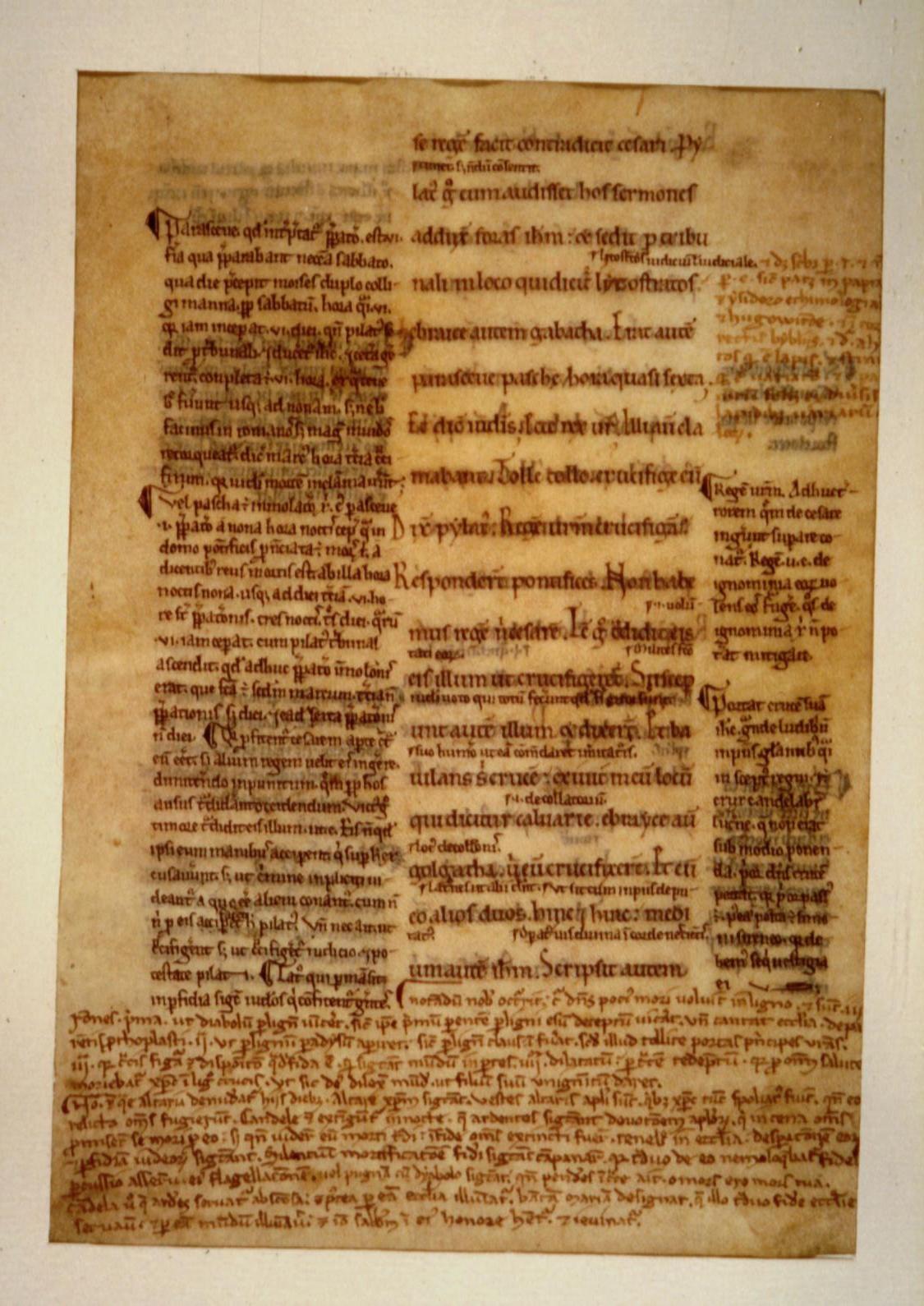
1. Switzerland: New Testament ( Testamentum Novum, cum Glossis Bedae, Hieronymi, et Gregorii).
Early XIIth Century. Latin Text; Revised Carolingian Script.
John 19.7-12, recto; John 19:12-19, verso.
... interlinear glosses and commentaries from the writings of Bede, Jerome, Gregory and other Church Fathers. These were inserted at various times during the following century around a central panel of the original text. All hands based on revival of early Carolingian minuscule. the beginning of the trend to compactness and angularity is seen in many of these later additions. 

'The colour and texture of the vellum is frequently an aid in allocating a manuscript to a certain district and time. The XIIIth century skins are often yellower than those of later dates as the result of the fact that a weaker lime-water solution was used in the bleaching process.'


3. Italy: Lectionary (Lectionarium; Secundam Lucam)
Middle XIIth Century, Latin Text; Revised Carolingian Script

 
A Lectionary contains selected readings from the Epistles and Gospels as well as the Acts of the Saint and the Lives of the Martyrs. These were read by the sub-deacon from a side pulpit. This practice necessitated that they be written in a separate volume, apart from the complete Missal. This fine large bookhand shown here, suited to easier reading in a dark cathedral, is a revival of the script developed nearly four centuries earlier in scriptoria founded by Charlemagne. Maunde Thomson calls this Lombardic revival the finest of all European bookhands. Even the XVth century humanistic scribes could not surpass it for beauty and eligibility.
 
The tone or hue of ink frequently helps allocate a manuscript to a particular district or century. Ink of brown tone is generally found in early manuscripts, less frequently after 1200 A.D.
 

"The quills used in writing were obtained from the wings of crows, wild geese, and eagles. To keep them sharp and their strokes of uniform width required skill and great sensitivity in hand pressure. It would be difficult to imitate or approximate the fine details even with the special steel lettering pens of today."

mr.scrivener

Monday, April 11, 2011

Vellum Bindings: 1750s - a quick peek

Recently we began to investigate the production of vellum, particularly that taken from unborn or recently born animals (and briefly the practice of book-bindings from human skin also came forward).   As vellum production appears largely to have become a lost art, it was interesting to note that a 'fine vellum' book cover was found on a recent antique book for sale on Ebay, namely a printing of a Greek strategy book.   Here are a few shots of this cover, and the vellum is certainly striking for its 'milky-white' look, while still maintaining a translucent edge according to the photos:


mr.scrivener